Table of Contents
Key Takeaways for Precision Nutrition
AI Integration: 2026 marks the definitive shift toward Personalized nutrition, powered by Artificial intelligence (AI) interpreting complex genomic and metabolic data.
Data Processing: Machine learning (ML) and Deep learning (DL) are critical for transforming genetic variants into actionable Dietary recommendations.
Core Goal: Moving beyond general health advice to achieve true Precision Health by optimizing individual metabolic pathways and mitigating chronic disease risk.
Clinical Focus: Leverage Nutrigenomics insights to address specific physiological markers, such as inflammation and nutrient absorption efficiency.
The Era of Precision Nutrition Defined
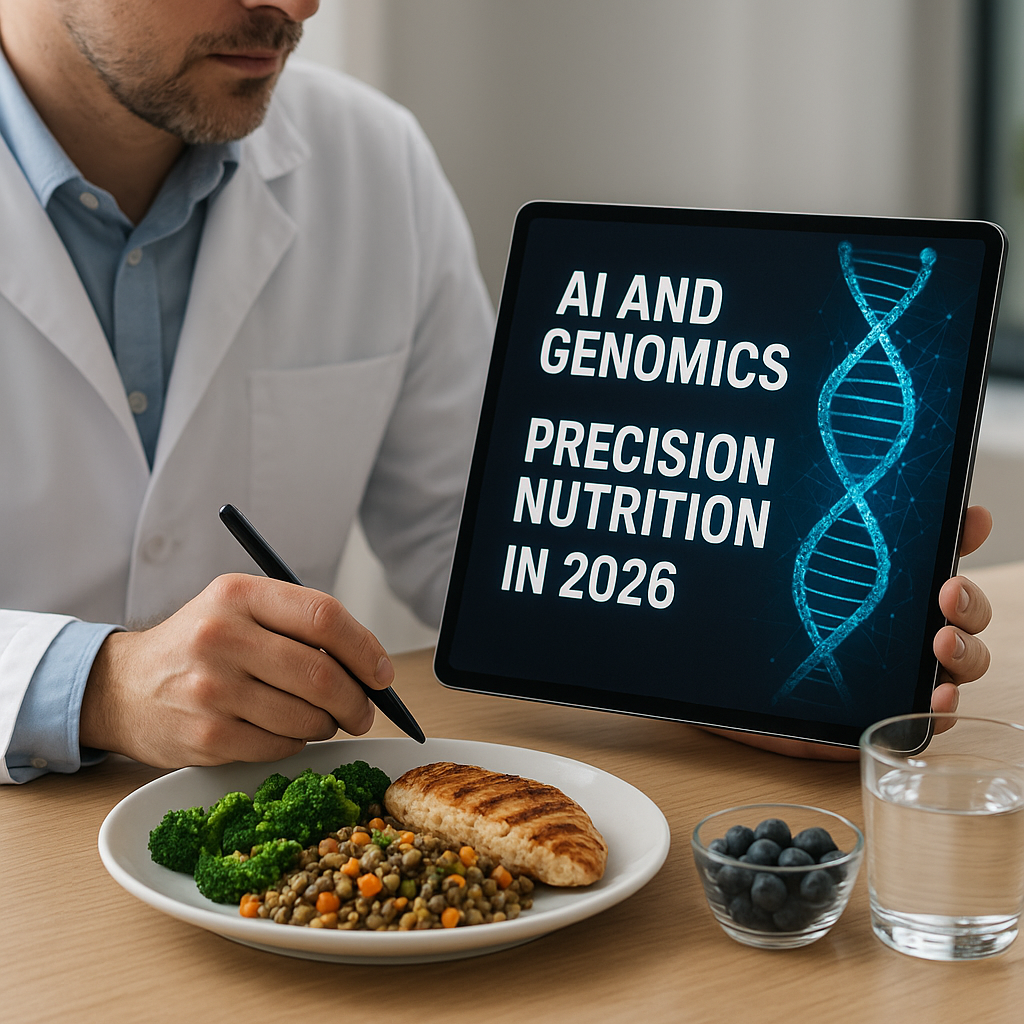
In January 2026, the generalized dietary advice of the past is obsolete. We have transitioned fully into the age of Precision Nutrition.
This paradigm shift is driven by the seamless integration of Artificial intelligence (AI) with advanced Nutrigenomics screenings.
The goal is simple yet profound, interpreting your unique genetic code and metabolic phenotype with unprecedented accuracy to deliver true Personalized nutrition.
The Computational Engine: AI and Machine Learning
Achieving this level of personalization requires processing petabytes of biological data, a task impossible without sophisticated computing power.
This synergy is powered by advanced Machine learning (ML) and Deep learning (DL) algorithms.
These systems analyze complex datasets, including genetic variants, microbial profiles, and real-time physiological markers, to generate highly specific Dietary recommendations.
This computational intensity allows for the effective use of Predictive analytics, moving us firmly into the therapeutic domain of Precision Health.
The Interplay of AI and Nutrigenomics
Your genetic blueprint dictates how efficiently you metabolize macronutrients, how you respond to inflammation, and your predisposition to specific nutrient deficiencies.
AI’s role is essential because human analysis cannot efficiently manage the volume and complexity of data required to isolate genuine gene-nutrient interactions.
We are no longer relying on correlational studies based on population averages. We are analyzing the individual metabolic pathway.
How Machine Learning Drives Personalized Nutrition
The foundational research that established the robust framework for this approach, particularly using Machine Learning to identify complex gene-nutrient interactions, was pioneered in 2024.
For instance, the seminal work by Waheed et al. demonstrated the efficacy of using federated learning models to train AI on diverse, large-scale genomic datasets without compromising patient privacy.
These models rely on sophisticated training sets to isolate genuine causal links from statistical noise.
This is where Deep learning (DL) excels, identifying subtle, non-linear patterns in metabolic pathways that dictate your optimal intake.
From Genetic Code to Actionable Dietary Recommendations
The output of this analysis is not merely a list of foods to avoid. It is a targeted strategy to optimize cellular function and mitigate risk factors.
For example, if genetic analysis reveals a polymorphism that hinders the efficient conversion of alpha-linolenic acid (ALA) to EPA/DHA, the AI delivers specific recommendations for pre-formed marine lipids.
Similarly, AI can predict individual glycemic responses to specific carbohydrate structures, allowing for real-time adjustments that prevent postprandial hyperglycemia and subsequent cellular stress.
This level of detail ensures that your Personalized nutrition plan addresses clinical concerns, such as reducing subclinical inflammation or preventing issues like progressive dyspnoea linked to metabolic dysfunction.
AI Beyond the Plate: Food System Resilience
While our focus remains on individual health, it is critical to acknowledge AI’s pervasive influence across the entire food supply chain.
The same advanced modeling used for personalized recommendations is simultaneously revolutionizing Food manufacturing and Food systems optimization.
AI is now indispensable for achieving Food system resilience globally.
Optimization and Quality Control in Manufacturing
In 2026, AI algorithms are standardizing and enhancing Quality control within Smart manufacturing facilities.
Using sensor data, AI performs Predictive maintenance on machinery, drastically reducing downtime and increasing throughput.
Furthermore, AI models analyze supply chain inefficiencies, directly contributing to Waste minimization efforts, aligning with critical Circular economy goals.
This integrated approach ensures the food products recommended by your personalized plan are consistently high-quality and ethically sourced.
The Paradigm Shift to Precision Health
The nutritional landscape is undergoing a profound transformation, moving decisively away from generalized, population-level dietary recommendations.
As of 2026, the definitive new frontier in health optimization is the convergence of Artificial Intelligence (AI) and Genomics. This synergy drives true Precision Health.
This fundamental shift emphasizes Personalized nutrition, tailoring targeted interventions based on your unique biological blueprint and real-time metabolic response.
You no longer need to rely on generic advice that fails to account for your specific genetic predispositions, the foundational data provided by Nutrigenomics.
This guide analyzes how advanced technologies, including Predictive analytics powered by Machine learning (ML) and Deep learning (DL), are actively future-proofing your diet and enhancing overall Precision Health.
Key Takeaways for Precision Nutrition
Personalized nutrition leverages Artificial intelligence (AI) to interpret complex genomic and phenotypic data, moving beyond traditional dietary models.
Nutrigenomics provides the foundational data, revealing how specific nutrients interact with your unique genetic variants.
AI, particularly Deep learning (DL) and Machine learning (ML), translates this vast dataset into highly accurate, real-time Dietary recommendations.
The goal is to move from reactive treatment to proactive, Predictive analytics within the Precision Health framework.
Ethical implementation requires strict adherence to data privacy and robust algorithmic transparency.
The Foundational Role of Genomics and Nutrigenomics
Genomics provides the essential, static map of your biological blueprint.
It offers crucial insight into your inherent health vulnerabilities and strengths, defining how your body processes key nutritional compounds.
This foundational data is the bedrock of true Precision Health.
The critical bridge between this genetic blueprint and actionable dietary intervention is the discipline of Nutrigenomics.
Defining Nutrigenomics
Nutrigenomics studies the dynamic interaction between your diet and your specific genome.
It investigates precisely how nutrients affect gene expression and, conversely, how genetic variations influence your specific requirement for essential macronutrients and micronutrients.
For instance, a particular single nucleotide polymorphism (SNP) might dictate an altered metabolic pathway for compounds like folate or active Vitamin D.
Understanding these precise gene-nutrient interactions is vital for preventing or managing chronic conditions.
This level of detail allows us to mitigate risk factors for cardiovascular disease or address specific, clinically defined symptoms, such as chronic aerophagia linked to unidentified dietary triggers.
Translating Genetic Potential into Personalized Nutrition
Raw genetic data is overwhelmingly complex and voluminous.
To yield actionable Personalized nutrition protocols, this data requires advanced computational models.
The traditional approach struggled immensely to synthesize thousands of gene variants simultaneously with dynamic lifestyle and environmental factors.
This is precisely the gap Artificial Intelligence (AI) is closing, transitioning genetic potential into highly specific, actionable dietary protocols.
Through Machine learning (ML) and Deep learning (DL) algorithms, AI performs Predictive analytics necessary to move raw data into defined strategies for Precision nutrition.
The Engine: Artificial Intelligence in Precision Nutrition
If genomics provides the static map of your biological blueprint, Artificial intelligence (AI) serves as the dynamic navigation system. It is the sophisticated engine processing massive streams of genomic, phenotypic, behavioral, and environmental data.
AI moves beyond simple statistical correlations to establish complex causal links, providing the foundation for truly adaptive and dynamic Personalized nutrition and robust Precision Health strategies.
Machine Learning and Data Integration
Machine learning (ML) algorithms are essential for integrating multimodal data. This includes raw genetic tests, continuous glucose monitor (CGM) readings, microbiome sequencing results, and detailed lifestyle metrics captured by wearable biosensors.
Fundamentally, ML identifies physiological patterns and interactions too nuanced or large-scale for conventional human analysis.
This computational power allows for highly accurate prediction of your individual metabolic response to specific food combinations or nutrient timing, driving effective Precision nutrition strategies.
Deep Learning and Predictive Analytics
A critical subset of ML is Deep learning (DL), which utilizes complex, multi-layered neural networks. DL models are required to handle the exceptionally large and often unstructured datasets inherent in modern Personalized nutrition research.
DL models excel specifically at Predictive analytics, allowing us to forecast long-term physiological outcomes based on current dietary adherence and real-time biological markers.
For instance, DL can predict the probability of developing specific metabolic dysfunctions, such as insulin resistance or progressive dyspnoea linked to chronic inflammation, years in advance, enabling preemptive clinical intervention.
"The power of deep learning lies in its ability to model non-linear relationships between thousands of genomic markers and dynamic physiological indicators, a feat impossible with previous statistical methods."
Dynamic Intervention and Real-Time Dietary Recommendations
The most immediate and transformative benefit of AI integration is the provision of dynamic, real-time Dietary recommendations.
If your wearable biosensor detects heightened sympathetic nervous system activity or an unexpected postprandial glucose spike, the Artificial intelligence (AI) platform instantly recalibrates subsequent meal plans.
This dynamic feedback loop ensures your nutritional advice remains relevant to your moment-to-moment physiological state, moving beyond the static blueprint provided by initial Nutrigenomics data.
AI’s Influence on the Future Food System
The impact of AI extends beyond the individual plate. The aggregation of anonymized data from millions of users provides unprecedented insight into systemic nutritional demands.
This data is already being leveraged by Food manufacturing partners for Smart manufacturing optimization. AI models utilize predictive consumption patterns to optimize production, leading to significant Waste minimization.
This contributes directly to achieving Circular economy goals and improving overall Food system resilience. Furthermore, AI enhances Quality control throughout the supply chain, from raw ingredient sourcing to final product delivery.
Leading research, such as that conducted by Waheed et al. on AI optimization in complex supply chains, confirms that this integration is crucial for scaling Personalized nutrition effectively across populations.
AI and the Optimization of the Glymphatic System
The scope of Personalized Nutrition extends far beyond optimizing simple macronutrient ratios. Optimizing neurological function is a critical, often overlooked component of holistic Precision Health.
The efficiency of the glymphatic system, which manages vital waste clearance in the central nervous system, is acutely sensitive to your metabolic state, hydration levels, and the precise timing of nutrient intake.
Modern Artificial Intelligence (AI) models are leveraging Deep Learning (DL) and Predictive Analytics to synthesize massive streams of data.
These algorithms are trained on detailed inputs, including sleep architecture data, chrononutrition patterns, and specific hydration biomarkers, providing a comprehensive view of your systemic status.
This sophisticated analysis allows Artificial Intelligence to deliver highly dynamic dietary recommendations specifically calibrated to support efficient glymphatic clearance. This targeted approach is foundational for bolstering long-term cognitive resilience and mitigating complex neurodegenerative risk factors, underscoring the shift toward true Precision Nutrition.
AI’s Role Beyond the Plate: Food System Resilience
While optimizing your individual metabolic profile using Personalized nutrition is paramount for Precision Health, this optimization is reliant upon systemic stability. The transformative influence of Artificial intelligence (AI) extends far beyond generating personalized Dietary recommendations.
It is fundamentally reshaping global Food systems and Food manufacturing efficiency. Achieving global health requires both individual optimization and robust systemic resilience.
Smart Manufacturing and Quality Control
AI enables true Smart manufacturing within the complex food supply chain. Utilizing advanced Machine learning (ML) and Deep learning (DL) algorithms, high-speed computer vision systems are deployed for instantaneous, non-invasive Quality control.
This technological integration significantly reduces the incidence of contamination and ensures robust nutrient consistency, a critical factor for specialized or fortified Personalized nutrition products.
Research detailed by Waheed et al. confirms the efficacy of these models in rapidly identifying microscopic anomalies, thereby improving food safety metrics across large-scale Food manufacturing operations.
Waste Minimization and Circular Economy Goals
Waste minimization remains a significant economic and environmental imperative within the global food structure.
AI addresses this challenge through sophisticated Predictive analytics. These models forecast demand fluctuations with unparalleled accuracy, directly minimizing overproduction and resultant spoilage.
Furthermore, Predictive maintenance protocols, driven by Machine learning, monitor complex Food manufacturing equipment in real-time. This prevents costly breakdowns that frequently precipitate massive product loss.
These integrated applications are essential for optimizing resource utilization, enhancing overall Food system resilience, and achieving defined Circular economy goals.
Federated Learning for Data Security
The integration of AI into Personalized nutrition and Nutrigenomics requires handling vast amounts of sensitive health data, necessitating stringent security protocols.
Federated Learning (FL) represents a key technological advance in protecting this highly sensitive genomic and phenotypic information.
FL allows complex Deep learning models to be trained across multiple decentralized devices or servers, where local data samples reside. Crucially, the raw data remains localized and private; only the learned parameters are aggregated and shared.
This methodology maintains exceptionally high levels of data security while simultaneously advancing the global accuracy and robustness of AI models used for Precision Health insights.
Navigating the Ethical and Practical Challenges
The successful optimization of individual metabolic profiles via Personalized nutrition is predicated not only on systemic stability, a requirement we addressed regarding Food system resilience, but also on rigorous ethical implementation.
While the promise of Artificial intelligence (AI)-driven nutrition is immense for Precision Health, responsible deployment requires immediate attention to several complex challenges.
These issues center primarily on data governance, equitable accessibility, and the inherent limitations and biases within the core Machine learning (ML) models.
Data Privacy, Governance, and Algorithmic Transparency
The collection of highly sensitive health data, including genomic sequencing, real-time metabolic markers, and microbiome profiles, demands an absolute commitment to user privacy and robust regulatory frameworks.
We must proactively mitigate the potential for secondary data harms and ensure stringent oversight prevents misuse of this deeply personal information.
Furthermore, algorithmic transparency is non-negotiable for building trust. Users and clinicians must understand precisely how AI, utilizing techniques such as Deep learning (DL), arrives at its Dietary recommendations.
We must vigilantly guard against opaque "black box" algorithms that offer recommendations without clear, auditable justification, as this undermines both accountability and clinical confidence in Precision nutrition tools.
The implementation of privacy-preserving techniques, such as Federated Learning, is crucial to allow models to learn from vast datasets without centralizing sensitive user information.
The Imperative of Equitable Access
Currently, comprehensive Personalized nutrition platforms integrating full genomic and phenotypic data analysis often carry a substantial cost. This economic barrier creates potential socioeconomic disparities in health outcomes, exacerbating existing inequalities.
This raises profound ethical concerns regarding who can afford to truly future-proof their diet using advanced Predictive analytics.
Efforts must focus on developing highly scalable, affordable AI tools that genuinely democratize access. The benefits of Precision nutrition must be available across all demographics, not just a privileged subset.
Comparison of Traditional vs. AI-Driven Nutrition
Understanding the value proposition of this technological shift requires a clear comparison of the methodologies. The transition from generalized population health advice to individualized metabolic optimization marks a paradigm shift in dietetics.
Feature | Traditional Nutrition Model | AI-Driven Precision Nutrition |
|---|---|---|
Data Basis | Population averages, Food Frequency Questionnaires (FFQs), generalized RDAs | Genomic, Microbiome, Phenotypic, Real-time Metabolic data (integrated via Machine learning) |
Recommendation Scope | Generalized guidelines (e.g., Food Pyramid, broad macros) | Hyper-specific, dynamic, real-time adjustments (micro-nutrient level, timing, and dosage) |
Feedback Mechanism | Slow, often based on subjective reporting or infrequent clinical check-ups | Instantaneous, continuous feedback loop via wearables and biometric sensors |
Focus | Disease management and broad prevention | Optimization of metabolic health, mitigation of specific risk biomarkers, and longevity |
Key Technology | Dietetics expertise, epidemiology | Deep Learning (DL), Predictive Analytics, Nutrigenomics |
The integration of Artificial intelligence (AI) allows for continuous optimization that traditional models cannot replicate, shifting the focus from managing disease to proactively maintaining optimal cellular function.
This dynamic feedback loop is the core driver of modern Personalized nutrition, ensuring that Dietary recommendations evolve as rapidly as your internal physiological state.
Future-Proofing Your Diet: Actionable Steps
While the ethical considerations surrounding Artificial intelligence (AI) and Personalized nutrition remain paramount, translating complex data into actionable, safe dietary shifts requires a methodical approach.
For individuals seeking to leverage these advances effectively in 2026, a structured, four-pillar framework is essential for achieving true Precision nutrition.
Step 1: Obtain Foundational Genomic and Phenotypic Data
You must begin with professionally validated genetic sequencing focused specifically on Nutrigenomics. This analysis provides the immutable blueprint governing nutrient metabolism, hepatic detoxification pathways, and your unique inflammatory response profile.
Pair this genomic data with robust initial phenotypic data. This includes comprehensive blood panels, addressing lipid profiles, inflammatory markers (e.g., highly sensitive CRP), and baseline metabolic function indicators.
Furthermore, consider initial baseline gut microbiome analysis. The integration of these static datasets is the critical first input for training the subsequent Machine learning (ML) and Deep learning (DL) models that will generate your specific Dietary recommendations.
Step 2: Integrate Dynamic, Real-Time Monitoring
Static reports are insufficient for dynamic metabolic optimization. Utilizing validated digital health tools provides the continuous data streams necessary for advanced Predictive analytics.
A Continuous Glucose Monitor (CGM) is highly recommended. It offers invaluable, real-time insight into your unique glycemic response to specific food matrices, timing, and exogenous stressors, which is crucial for preventing chronic metabolic dysregulation.
This data collection must be intentional. Focus on actionable biomarkers that provide high-fidelity inputs for the Artificial intelligence (AI) system, allowing for the precise calibration of recommendations based on immediate physiological status.
Step 3: Select a Validated AI Platform
Choosing the correct technological partner is non-negotiable. Select Personalized nutrition platforms that utilize highly validated Machine learning (ML) models derived from robust clinical cohorts.
Demand clear algorithmic transparency. You must understand the data inputs (genomic, phenotypic, real-time) that drive the specific output recommendations.
The optimal platform will integrate all your data points dynamically, offering iterative adjustments to your Dietary recommendations rather than presenting static, generalized reports. This dynamic capability is the essence of Precision Health.
Step 4: Consult with a Precision Health Practitioner
While AI tools are highly effective in processing vast quantities of data, they function as sophisticated decision support systems. They do not replace clinical judgment.
You must work collaboratively with a registered dietitian or physician who is explicitly trained in Precision Health and Nutrigenomics.
This expert oversight is essential for interpreting complex or conflicting results, particularly concerning pre-existing conditions or subtle clinical markers (for instance, ensuring AI recommendations do not exacerbate conditions like progressive dyspnoea or mask complex metabolic disorders).
The successful future of Personalized nutrition is fundamentally collaborative, combining the processing power of Deep learning (DL) with the necessary expert human oversight to ensure recommendations align with established clinical best practices and individual safety profiles.
This integration of individual data with expert guidance also feeds crucial feedback loops back into the larger Food systems, ultimately contributing to greater Food system resilience through precise demand signaling and waste minimization.
Frequently Asked Questions
What is the distinction between Personalized Nutrition and Precision Nutrition?
While often used interchangeably, understanding the technical difference is crucial for engaging with Precision Health initiatives. Precision nutrition represents the broader scientific discipline. It relies on comprehensive, high-resolution data, including Nutrigenomics, metabolomics, and phenotypic data, to identify specific biomarkers and mechanisms.
In contrast, Personalized nutrition is the practical, targeted application of those findings. It involves translating the scientific output from Precision nutrition models (often powered by Artificial intelligence (AI) and Machine learning (ML)) into actionable, individualized Dietary recommendations for the end-user.
Is Artificial intelligence currently being deployed in Food Manufacturing Optimization?
Yes, its deployment is extensive and foundational to modern Food systems. AI is indispensable in optimizing complex supply chain logistics and enhancing Food manufacturing efficiency.
Key applications include advanced Quality control using computer vision and Deep learning (DL) models, enabling real-time detection of contaminants or defects. Furthermore, Predictive maintenance protocols reduce downtime, supporting both Waste minimization and broader Circular economy goals, thus strengthening overall Food system resilience.
How does Federated Learning protect sensitive genetic data?
Federated Learning is a crucial privacy-preserving architecture in Personalized nutrition. It addresses the inherent risk of centralizing highly sensitive data, such as genetic or complex phenotypic profiles.
The core mechanism involves training the Machine learning (ML) model directly on your local device or secure institutional server. Critically, your raw data never travels outside this secure environment. Only aggregated model parameters and generalized insights, not the underlying individual data, are shared globally, substantially mitigating the risk of data exposure and enhancing trust in AI-driven Precision nutrition tools.
Can AI provide meaningful support in managing chronic conditions, such as Type 2 Diabetes?
Undoubtedly. Artificial intelligence excels in managing dynamic, data-intensive chronic conditions. For Type 2 Diabetes, AI leverages Predictive analytics to process continuous streams of data from Continuous Glucose Monitors (CGMs) and other biometric sensors.
This allows for highly precise, real-time adjustments to macronutrient ratios, meal composition, and timing. By moving beyond generalized dietary mandates, AI supports optimized glycemic control, forming a cornerstone of modern Precision Health strategies.
References
Artificial intelligence in personalized nutrition and food manufacturing
Harnessing Artificial Intelligence and Precision Diets for Brain ...
The Role of Artificial Intelligence in Personalized Nutrition
2026 North America Nutrigenomics Market - AI Integration & Digital ...
How leveraging AI in nutrition can help prevent the next global ...
Comments
Post a Comment