You probably remember that one stubborn plateau when a few extra inches of bar path felt impossible. I do — I once chased full squats for months until a nagging hip tweak led me to experiment with lengthened partials. That detour taught me more about mechanical tension, joint stress, and programming nuance than any 'always do full ROM' mantra. In this short post you'll get a second-person, practical take on partial reps vs full range of motion: when each helps muscle growth, how to protect joints, and how to combine them without wrecking mobility.
Quick brainstorm: 4 angles to explore
1) Biomechanics: Mechanical tension muscle across the range
Start with Partial reps vs full: full ROM spreads work across more joint angles, while partials concentrate effort where you choose. A key idea from exercise physiology (see PMC articles on hypertrophy mechanisms) is that mechanical tension is a main driver of growth. Lengthened partial reps keep the muscle under high tension in the stretched position, and research suggests they may produce superior hypertrophy there. Contrast that with “top-half” partials, which often feel strong but may shift stress toward joints or lockout leverage.
2) Practical programming: where partials fit in a session
Use examples you can picture, like a gym lifter chasing size, a rehab client rebuilding tolerance, and a strength athlete peaking for performance (common programming themes you’ll see in Men’s Health, Muscle & Fitness, NASM, and Paragon Training).
Lengthened partial reps: after full-ROM sets on curls, leg press, or RDLs to load the stretched range.
End-range partials: to practice control near the bottom or top when full ROM breaks down.
Strongest-point partials: overload lockout on bench/squat for a strength athlete.
3) Safety and rehab: partials as a joint-friendly bridge
Partials can reduce joint stress when full depth hurts, letting you train without flaring symptoms. For a rehab client with an irritated tendon, you can progressively load a pain-free angle first, then expand ROM over weeks (a common NASM-style progression). This is where partials shine for injury prevention: you keep training capacity while respecting tissue limits.
4) Long-term mobility: do partials steal your end-range strength?
If you only train partials, you may get strong only where you practice. Full ROM supports end-range strength and movement options. A balanced plan uses partials as a tool, not a replacement, so you keep mobility while still targeting growth and performance.
Biomechanics & hypertrophy stimulus — Partial reps vs full
How Partial reps vs full changes the growth signal
When you compare Partial reps vs full range of motion (ROM), you’re really changing where the muscle produces force and how long it stays loaded. Full ROM usually gives you more Time under tension exercise because you travel through the whole arc, loading more fibers across more joint angles. That’s why controlled research often shows bigger total gains in Muscle growth hypertrophy with full ROM.
Why Lengthened partial reps can hit hard
Lengthened partial reps keep the muscle working in the stretched position (the “bottom” range). This matters because mechanical tension is often highest at longer muscle lengths, and exercise physiology work (including PMC summaries) links that stretch-loaded tension to stronger growth signaling like mTORC1. In plain terms: Lengthened partial reps can create a very strong local stimulus, even if the rep is shorter.
Mechanical tension: high in the stretched range; a key driver of Partial repetitions hypertrophy.
Metabolic stress: partials can “burn” fast, especially with short rests, adding another growth trigger.
Regional hypertrophy: you can grow more in the portion of the muscle that stays under tension (localized growth).
What the numbers suggest (strength + thickness)
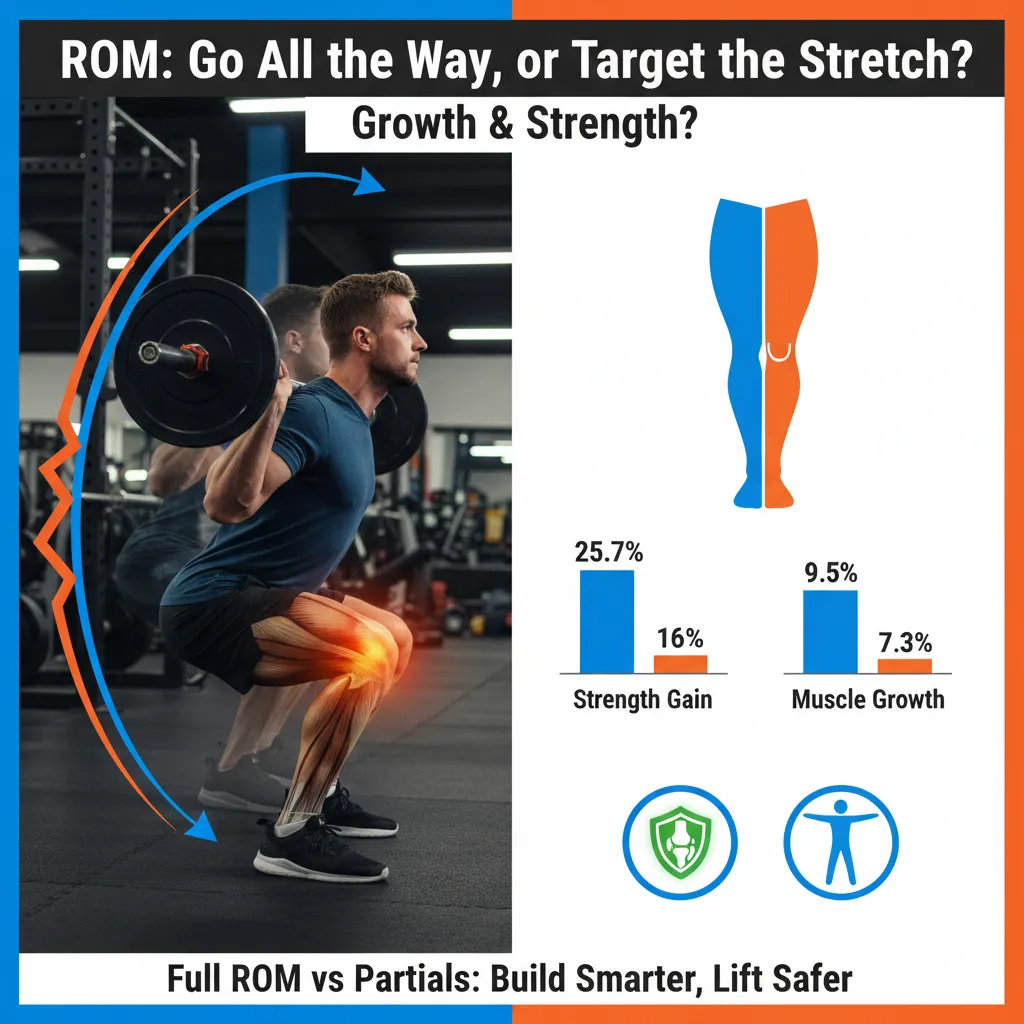
Articles in Men’s Health, Better Humans, and Muscle & Fitness often summarize the same takeaway: full ROM is the safer default for balanced development, while Lengthened partial reps are a smart tool. In controlled studies, full ROM showed 25.7% strength improvement vs 16% for partial ROM, and muscle thickness rose 9.5% with full ROM vs 7.3% with partials.
Outcome | Full ROM | Partial ROM |
|---|---|---|
Strength improvement | 25.7% | 16% |
Muscle thickness increase | 9.5% | 7.3% |
Emerging evidence suggests Lengthened partial reps may be comparable—or even better—for stretched-position hypertrophy in specific regions, while full ROM still tends to win for overall size.
Joint stress, injury prevention, and rehab applications
Range of motion training that protects sore joints
When full reps hurt at certain angles, you can use Range of motion training with partials to avoid the painful end range while still training the muscle. This is one of the most practical Partial reps benefits for Strength training injury prevention: you keep moving, keep blood flow high, and reduce joint stress where tendons or cartilage feel “pinchy.” NASM-style guidance often treats partials as a short-term tool to manage symptoms while you rebuild capacity.
Using partials at the weakest range for safer loading
Paragon Training Methods commonly frames partials as rehab and accessory work: you pick the weakest point (where you usually fail), then use a lighter load and smaller motion to build tolerance. Because the load must drop to control that weak range, the injury risk is usually lower, and you can progressively reload tissues while preserving joint integrity. This also supports Partial repetitions muscle growth when full ROM is limited, since you can still create tension without forcing painful depth.
Use partials when full reps cause pain, especially near end range.
Keep the load light and add reps or small ROM increases first.
Stop before sharp pain; aim for mild discomfort at most.
Practical rehab example: eccentrics + lengthened partials
For a recovering tendon (like patellar or Achilles), try controlled eccentrics through a comfortable range, then add lengthened partials only in the pain-free portion near the stretched position. Example: 3–5 second lowering, then 6–10 short partials at the bottom where you can stay smooth and stable.
Caveat: don’t let partials replace full ROM
If you rely on partials forever, you may get strong only in the middle and stay weak at end ranges. Over time, that can limit mobility and reduce resilience. In rehab, partials should complement full ROM work, not replace it—gradually earn back full depth as symptoms calm.
Programming and technique — How you should use partials with full ROM
Partial reps benefits: use them to add, not replace
Yes, partial reps count. They can drive growth and strength when you place them where they make sense. But for long-term muscle health, you still need full ROM work to keep mobility and end-range strength. Think of partials as a tool for overload and extra tension, while full ROM stays your base.
Increase strength with partials (strongest-point overload)
End-of-set partials in your strongest range let you handle heavier loads or more reps after fatigue. This is Maximizing short movements training for strength: you overload the top half of a press, the last third of a squat, or the lockout of a deadlift without grinding risky reps at your weakest point.
Templates that blend full ROM + partials
Main sets: 3–5 sets full ROM (strength or hypertrophy focus).
Drop work: 1–2 drop sets of lengthened partials (stretched position) for 6–12 reps.
Session finisher: 2–4 sets of strongest-point partials for 6–10 reps.
Example: After 3 sets of full-range squats, finish with 2 sets of lengthened partials in the bottom position for 6–8 slow reps to emphasize stretch tension.
Progressive overload training without joint payback
Progress partials conservatively: add 2.5–5% load or 1–2 reps only when your joints feel good and your full-ROM numbers stay steady. Track perceived joint comfort and your ability to control the end range; if full-ROM depth or lockout strength drops, reduce partial volume.
Sample microcycle (week)
Day | Focus | Plan |
|---|---|---|
Mon | Full-ROM strength | Squat/press 3–5x3–6 + 1 strongest-point partial set |
Wed | Full-ROM strength | Hinge/row 3–5x3–6 + 1 strongest-point partial set |
Fri | Partial-focused hypertrophy | Full ROM 2–3x6–10 + 2–4 sets lengthened partials 6–12 |
Wild cards: analogy, hypothetical scenarios, and a tiny confession
Analogy: mural vs fine brush (Partial reps benefits)
Think of full ROM like painting the whole mural. You cover the background, the main shapes, and the edges so the picture makes sense from far away. Partial reps are like zooming in with a fine brush on one corner. You add detail where the mural looks flat. Partial reps benefits show up when you use them to stress a specific joint angle or muscle length that full ROM doesn’t load as hard. But the mural still needs the wide strokes, because full ROM keeps your movement skill, control, and tolerance across positions.
Hypothetical: one technique for a month (Regional hypertrophy training effects)
If you could only pick one method for 30 days, full ROM is the safer long-term bet for muscle health and injury prevention. You practice strength through the whole range, and you don’t “forget” the bottom or top positions.
But here’s the twist: if you have a stubborn muscle area, a month of lengthened partials could create surprisingly specific changes. That’s the idea behind Regional hypertrophy training effects: you can bias growth toward certain parts of a muscle by loading certain ranges harder. Creative thought experiments like this help you decide when to prioritize full ROM vs partials for your goal.
Tiny confession: my 3-week pull-up experiment
I hit a pull-up plateau and my elbows felt cranky. For three weeks, I kept some full ROM work, but I added lengthened partials (bottom-half reps) with controlled tempo. I noticed two things: more “meat” in the mid-back/lat area (a regional look), and less tendon soreness after sessions. That’s not a controlled study—personal experiments are not substitutes for controlled studies—but they can guide practical programming.
Use full ROM as your base.
Add lengthened partials as a targeted tool, not a replacement.
Take-home action steps and 'Yes, partial reps count'
Take home message training: lead with full ROM, then add partials with purpose
If you want the best mix of size, strength, and long-term joint function, you should make full range of motion your default. In at least one controlled comparison, full ROM produced bigger gains than partials: 25.7% vs 16% strength, and 9.5% vs 7.3% muscle thickness. That’s your baseline for Best practices muscle health. Still, Yes partial reps count—they are effective tools for hypertrophy and strength when you use them with intention, not as a shortcut.
Where partial reps shine
Use lengthened partials (the bottom half where the muscle is stretched) to push “stretched-region” tension when full ROM fatigue limits you. Use strongest-point partials (the top half where leverage is best) to overload safely with heavier loads, especially at the end of a set when full ROM reps slow down. This lets you keep mechanical tension high without forcing sloppy reps through painful end ranges.
Practical checklist you can follow
Reserve full ROM for your primary heavy work.
Use lengthened partials for extra stretched tension after full ROM reps.
Employ strongest-point partials at set endings for heavy overload.
Monitor end-range strength weekly to ensure you’re not avoiding weak positions.
If you’re rehabbing, start with lighter partials only in pain-free angles, then slowly reintegrate full ROM as your tissue tolerance improves. Keep progressive overload steady, chase clean mechanical tension, and combine full ROM plus smart partials to build muscle while protecting your joints.
TL;DR: Both partial reps and full ROM can build muscle and strength. Full ROM generally wins for overall hypertrophy and mobility; lengthened partials can match or exceed hypertrophy at long muscle lengths and are useful for overload and rehab. Use partials as a complement, not a replacement.
Comments
Post a Comment