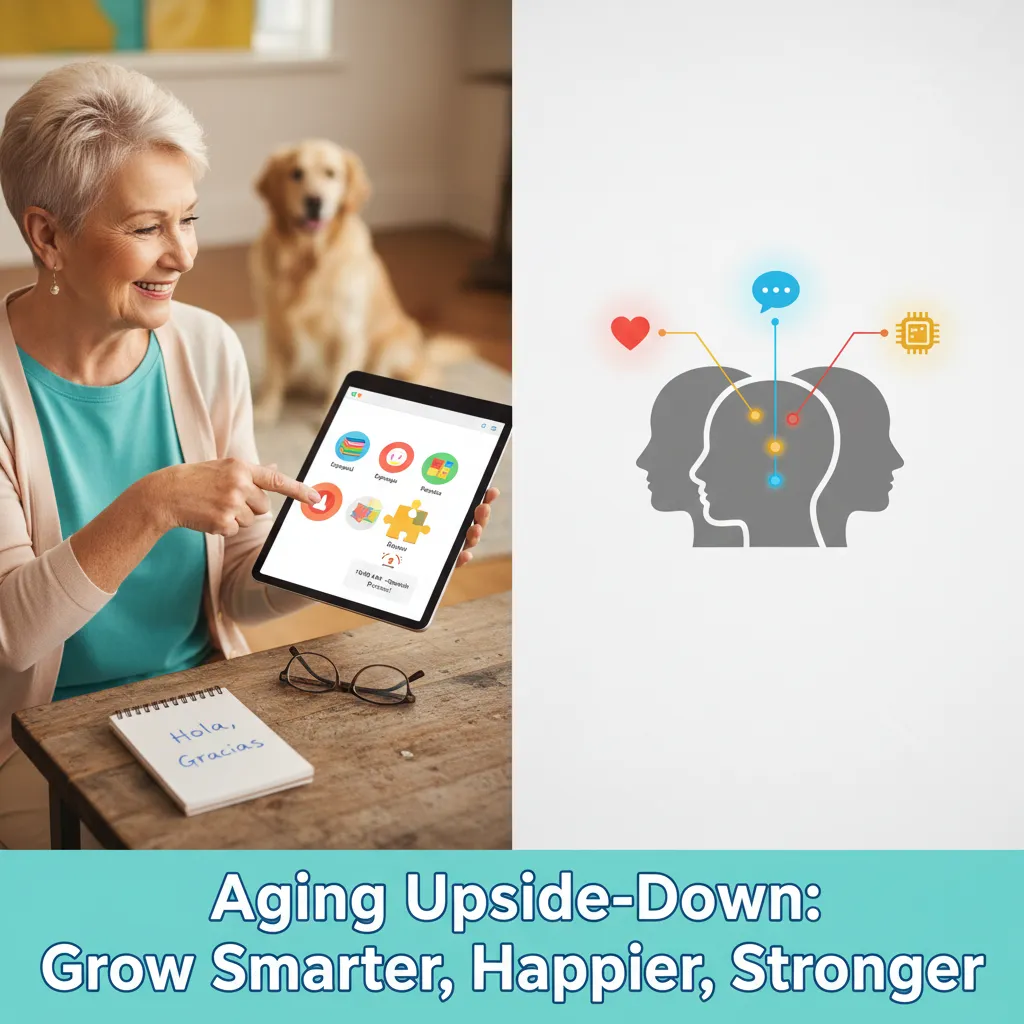
You probably expect a sad story about decline when someone says “aging.” Here’s a different opener: the first time I taught my neighbor in her seventies to use a tablet, she not only learned the tech but outpaced me in remembering names. That small, sweet surprise is a doorway into research showing that as you age you can gain emotional regulation, vocabulary, and even neurobiological resilience. This outline nudges you through those upside-down truths—evidence, lived examples, and practical takeaways—without pretending aging is flawless.
1) Cognitive Gains & Lifelong Learning (Positive cognitive changes aging)
You keep learning: Aging cognitive improvements are real
One of the most overlooked Positive cognitive changes aging brings is that you can still learn—often better than you expect. While some processing speed may slow with age, research and guidance from the National Institute on Aging (NIA) note that many thinking skills stay steady, and some can even grow with practice. You can still form new memories, build new habits, and improve skills over time.
In fact, studies in 2024–2025 continue to show that older adults retain learning capacity. That means if you start a new hobby—music, painting, coding, or a sport—you’re not “too late.” You’re training your brain to adapt.
Vocabulary and language can strengthen with age
Another area of Aging cognitive improvements is language. Your vocabulary and word knowledge often expand across adulthood because you’ve had decades of reading, conversations, and life experience. If you take a language class now, you may notice that while memorizing may take more repetition, your understanding of meaning, context, and patterns can be a real advantage.
Cognitive reserve: your brain’s “backup system”
Cognitive reserve is the brain’s ability to cope with age-related changes or even disease changes by using stronger networks and flexible strategies. Mental stimulation—classes, puzzles, learning a language, volunteering, and staying socially active—helps build this reserve. Research links higher cognitive reserve to a lower risk of dementia symptoms showing up early, even when brain changes are present.
Some large studies also suggest that combining multiple healthy behaviors (often 4–5 lifestyle factors) can reduce Alzheimer’s risk by up to 60%. Mental activity is one of those key behaviors.
Prospective memory dementia: using support to stay independent
Prospective memory dementia concerns “remembering to remember,” like taking medicine at 8 PM or paying a bill on Friday. If you have memory problems, reminder supports can protect independence. Simple tools—phone alarms, calendars, pill boxes, and written checklists—are proven, practical interventions.
Example: learning at 70 still works
Imagine you’re 70 and start studying Spanish. With steady practice, you can improve vocabulary, build new memory links, and strengthen prospective memory by pairing study time with reminders (for example, an alarm labeled “Spanish at 10 AM”).
Try: a class, language app, or weekly group
Train: attention with puzzles or reading
Support: future tasks using reminders and routines
2) Emotional Regulation, Happiness & Subjective Age (Emotional resilience aging)
Aging brings happiness (and the data challenges stereotypes)
You may be surprised by how often aging brings happiness. Large studies find that many older adults report being as happy or happier than younger adults, even when life includes health changes or losses. This goes against the common story that aging is mostly decline. One reason is that, with time, you often get clearer about what matters and spend less energy on things that drain you.
Emotional resilience aging: you get better at handling hard moments
Emotional resilience aging is not just “being tough.” It’s the skill of recovering after stress and keeping your mood more steady. As you age, you often improve at:
Choosing your focus (giving more attention to positive, meaningful experiences)
Letting go faster (less rumination after conflict or disappointment)
Using better coping tools (reframing, acceptance, and problem-solving)
This stronger emotional regulation can protect your relationships and support brain health by lowering long-term stress load.
Subjective age well-being: how old you feel can shape outcomes
Your subjective age well-being—the age you feel, not just the age on your ID—matters. Research links “feeling younger than your chronological age” with better mental health, stronger physical function, and even better cognitive performance. When you see yourself as capable and still growing, you’re more likely to stay active, stay social, and keep learning—behaviors that support the brain over time.
Psychological factors biological aging: loneliness can speed the clock
Your mindset and social world don’t just affect mood; they can affect your body. Research suggests that psychological factors biological aging include loneliness and unhappiness, which are linked to faster aging—by about 1.65 years in biological age. That makes emotional health a real health factor, not a “nice to have.”
Practical note: When you rewrite your narrative about aging—from “I’m fading” to “I’m adapting”—you may change daily choices (sleep, movement, connection) that influence stress biology and long-term health.
3) Social Connection, Pets & Lifestyle Buffers (Power social connection)
Power social connection: why variety in your relationships matters
Your brain does not only benefit from having people around—you benefit from having different kinds of people around. Research insights suggest that social connection variety supports cognition and emotional well-being. In practice, that means mixing family time, friendships, neighbors, community groups, and casual “weak ties” (like a familiar barista or walking buddy). This variety can strengthen attention, memory, and mood, and it supports longevity.
When you invest in Social relationships aging well, you also build a buffer against stress. Strong social support mental health can lower feelings of threat and help you recover faster after hard days. Even small, regular contact—short calls, shared meals, or group classes—adds up for social activities cognitive health.
Pets as emotional buffers: Pet ownership mental health
If you live alone or feel isolated, a pet can act like a steady “social bridge.” Findings highlighted in HABRI Foundation research link Pet ownership mental health benefits to lower loneliness and fewer depressive symptoms, especially for older adults living alone. Pets also create routine: feeding times, walks, grooming, and vet visits give your day structure and gentle purpose.
Pets can also increase human contact. A dog walk often leads to quick chats with neighbors, which strengthens Social relationships aging through simple, low-pressure connection.
Lifestyle bundles that protect your brain: Physical activity brain health + food + habits
Single healthy choices help, but a bundle helps more. Evidence suggests that doing four to five healthy behaviors—such as regular movement, a Mediterranean-style eating pattern, not smoking, and ongoing mental stimulation—can reduce Alzheimer’s risk by about 60%. This is where Physical activity brain health becomes a daily tool, not a one-time goal.
Mix social groups: rotate between a class, a hobby group, and one-on-one time.
Consider a pet (if feasible): start with fostering or volunteering at a shelter.
Move gently every day: walking, light strength work, or stretching supports Physical activity brain health.
Eat Mediterranean-style: vegetables, beans, fish, olive oil, nuts; limit ultra-processed foods (Mediterranean diet brain support).
Use trusted guidance: explore NIA resources on brain health for practical, age-friendly steps.
4) Neurological Markers & Interventions (Clinical trials brain aging)
You can influence brain biology with Breathing interventions stress
As you age, your brain is not just “declining”—it is also adapting. Evidence from Clinical trials brain aging suggests you can shape brain-related markers with simple daily habits. In slow-paced breathing studies, older adults who practiced calm, steady breathing showed signs linked to healthier brain aging, including lower amyloid-beta (a marker connected to Amyloid plaque Alzheimer’s) and increased hippocampus volume. Because the hippocampus supports learning and memory, these findings connect directly to Hippocampus memory processes.
These results do not mean breathing “prevents Alzheimer’s.” They do suggest your nervous system responds to training, and that stress regulation may be one pathway that supports brain health over time.
Biomarkers matter: Heart rate variability and hippocampus change
Researchers track brain aging using biomarkers—measurable signals from your body and brain. One practical marker is Heart rate variability (HRV), which reflects how flexibly your body shifts between stress and recovery. Higher or more adaptive HRV patterns are often linked to better stress resilience and emotional regulation, which can support attention and memory in daily life.
At the brain level, hippocampus structure and function are also monitored because they relate to Hippocampus memory processes. When studies report hippocampal volume changes alongside stress-related markers, it strengthens the idea that managing stress can support memory-relevant brain systems.
Clinical supports for memory: reminders and care-partner strategies
If you are living with mild cognitive impairment or early dementia, you can still protect independence with the right supports. Clinical guidance (including NIA overviews and applied research) highlights reminder interventions that strengthen prospective memory—your ability to remember to do things later (take medication, attend appointments, turn off the stove).
External reminders: phone alarms, calendars, pill organizers, labeled routines.
Care-partner strategies: shared checklists, consistent cueing, and simplifying steps.
Environment design: keeping key items in one place to reduce memory load.
Interventions vary by study, so replication and clinical guidance matter—use trial findings as a starting point, not a substitute for medical advice.
Wild Cards: Quotes, Analogies & Tiny Thought Experiments
Quote to sit with (and test in your own life)
“How old you feel is more predictive of health outcomes than your birth date.” — Dr. Susan Charles.
Read that again, slowly. If your “felt age” shapes your choices, your stress, and your hope, then Rewriting narrative aging is not just positive thinking—it’s a practical health skill. Research suggests psychological factors like loneliness and unhappiness can add about ~1.65 years to biological age. So when you shift your story from “I’m declining” to “I’m adapting,” you may be supporting your mind and your body at the same time.
Analogy: your brain as a library
Think of your brain like a library: aging doesn’t burn books; it reorganizes them and sometimes writes wiser forewords. You may not grab every title as fast as you did at 25, but you often know which shelf to go to. That’s the quiet neurological benefit of experience—pattern recognition, better emotional balance, and a stronger sense of what matters. This is one reason Older adults happiness can rise later in life: you’re not starting from scratch; you’re using a well-stocked collection.
Tiny thought experiment: social variety for one week
Here’s a simple way to feel the link between Social support mental health and your daily brain function. For one week, track your social variety: a phone call, a face-to-face chat, a group class, a short message to a friend, or helping someone with a task. Research hints that small experiments like this can reveal real effects on mood and attention—sometimes faster than you expect.
Day | Social variety (what + who) | Mood (1–10) | Attention (1–10) |
|---|---|---|---|
Mon | Call + neighbor chat |
A quick anecdote: my neighbor started teaching herself a tablet at 72, then began showing others how to use video calls. Her memory didn’t “magically” change overnight, but her confidence did—and her days got brighter because she had more connection and purpose.
If you try the week, notice what lifts you most. Then keep that one habit. Pair it with healthy behaviors—because studies suggest 4–5 healthy behaviors can cut Alzheimer’s risk by about 60%. Aging isn’t only time passing; it’s a story you can edit, one small choice at a time.
TL;DR: You gain more than you lose: older adults often have higher emotional resilience, richer social buffers, measurable brain benefits (hippocampus volume, lower amyloid markers with interventions), and lifestyle choices can cut Alzheimer's risk by up to 60%.
Comments
Post a Comment